The Eviction Lab effectively encompasses three core digital humanities values indicated across the website.
Accessibility
The Lab wields accessibility efforts in two ways. By prioritizing a wide-ranging audience’s understanding and online operability, accessibility is at the forefront of Eviction Lab, tailored to fit anyone’s needs visually and textually. This way, Eviction Lab effectively ensures their content meets further digital outreach.
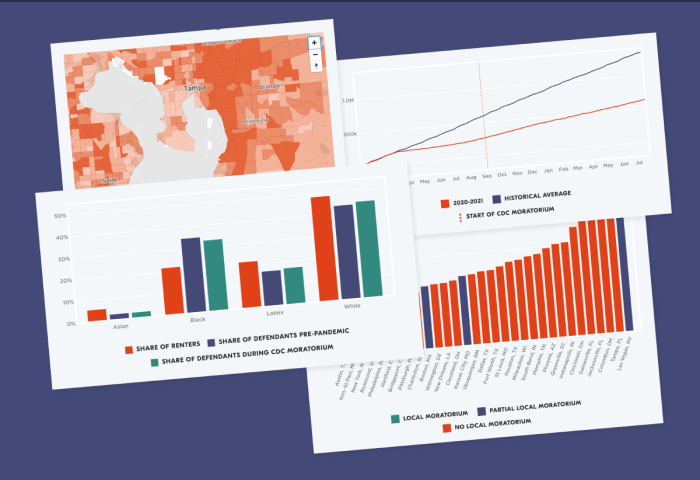
Further, Eviction Lab is readily updated and prides itself on the audience’s options for access, such as timely reporting and blog posts. The Lab has amassed 99.9 million records of data pertaining to evictions nationwide. This data is pulled from state court records and the Census in order to visualize it on the US map for site visitors, allowing a simpler statistic to access opposed to solely text. Eviction Lab has even narrowed down its data to all 50 state counties as well as the nation’s capital.
The website displays bar graphs, bullet points and charts to represent its logistics.

Openness
The aspect of openness in digital humanities is a transparent process by which a source publicly releases data, statistics or project results to the public for their greater benefit and knowledge on a subject.
Eviction Lab is dedicated to nationally providing transparent statistics on eviction rates and filings, complete with a research-dedicated page outlining a list of hyper-linked key findings. It demonstrates the uneven distribution of eviction notices and filings throughout all 50 states, with their public openness allowing for data to be saved and downloaded.
Findings are assorted into categories of prevalence and location, demographics at highest eviction risk, consequences of eviction, tools to address the crisis, protections and protocol during COVID-19, landlords and the rental market, as well as zoning, housing and eviction data.
Documentation
With organized knowledge and findings, documentation is integral to any site in serving as a digital catalog of reference guides that answer the: who, what, when, where, and why.
Adequate research prior to the creation of a website is paramount in attracting viewership and obtaining credibility. In digital humanities, documentation employs digital tools to review a topic, analyze existing data and generate new methods of displaying content.
Data is updated monthly split into sections, effectively documenting an overview of which cities and states are tracked, detailed reports from court systems, along with hyperlinks to explore their tracking systems.
