With the technology available today, many game developers can draw data straight from games played online and use that information to make changes to the game if one character/weapon/strategy/etc is over- or under-performing to the extend it warrants a change. However, with Super Smash Bros Ultimate, there are 2 issues: a) a lot of the gameplay that developers could use to evaluate game balance happens offline and is unable to be collected through traditional means, and b) Nintendo doesn’t share that game data with the game’s player base. Currently, there is no way for people to access statistics such as character usage. Usually this is done through a public API (Application Programming Interface) made available by the developers, but Super Smash Bros Ultimate does not have one.
The methodology will be broken down in two parts: the methodology behind running a tournament, and the methodology behind the data collection. Before we can cover data methodology, it’s important to understand how a Super Smash Bros Ultimate tournament works.
Tournament Methodology
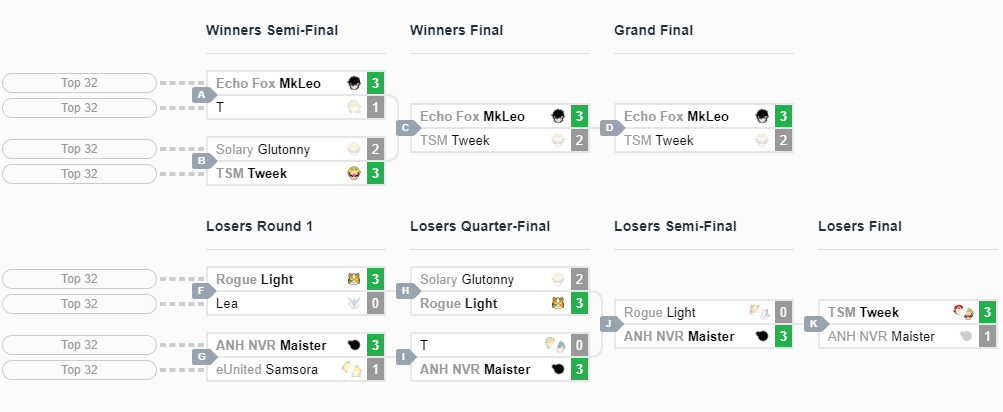
Players are put into a bracket, usually generated by an online bracketing service like smash.gg or challonge.com, and the event administrators call the matches to be played. All matches in the event are best-of-X style, with earlier matches being best-of-3 (first player to win 2 games is the winner) and matches later in the bracket switching to best-of-5 (first player to win 3 games is the winner). At the beginning of the match, players will do rock-paper-scissors to determine who gets to pick the stage, and then both players pick their characters. For all games after the first, the winner of the previous game gets to ban some of the stages (usually 2, but the number of bans varies on how many stages are legal), and then players chose characters for the next game. Players are not “locked in” to the character they picked the first game, however the winner of the previous game must pick their character first, before the loser picks their character.
Project Methodology
The data for this project will be collected via a Google Form submission. The data model is as follows (and is subject to change):
- Name of the tournament
- Link to the bracket
- Which stage the game was played on
- The winner of game 1
- The character the winner played
- The loser of game 1
- The character the loser played
Numbers 3-7 are repeated for each game in the set, with a minimum of two games and a maximum of five games.
After the data is submitted, it is automatically put into a Google Sheet where it can be sorted in a variety of ways. With the built-in features of Google Sheets, graphics can be made very easily with the data being already sorted.
