https://www.sqrlab.ca/papers/MB2024_chapter.pdf
This project comes from Seer Labs which explores the idea of implementing Serious Games, or educational games to help teach students various topics.
Most of this project’s development and research was completed between 2018-2020 for Michael A. Miljanovic’s PhD.
This project discusses the development of adaptive serious games using the implementation of machine learning in order to create personalized learning. It builds on top of the idea of how game-based learning can help provide entertainment and aid in learning. But it also explains that it is not the same as gamification, i.e. Duolingo, which takes ideas and adds aspects of games to them, like leaderboards.
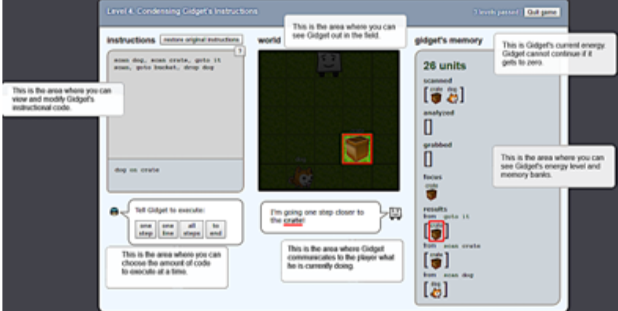
It brings to light the serious game Gidget.
This serious game has players correct bugs in code to navigate the Gidget character and provide instructions to complete various tasks on a two-dimensional grid map. They discuss the possibility of creating a machine learning version to adjust gameplay based on how the user is doing. And this is Miljanovic’s goal in order to use Gidget as a foundation to make other serious games adaptive with machine learning.
Miljanovic lays out a framework consisting of four steps in order to update a game with machine learning.
The four key phases for updating a serious game with ML:
- Identify a potential adaptive game
- Model game play tasks and the ability of learners
- Build ML and supporting functionality into the existing code base.
- Evaluate the benefits of the adaptive modifications.

The identification phase requires three major learning factors to be considered before applying adaptation. These factors are, understanding of the learning outcomes, the experience and demographic of the learners, and the learning evaluation. The model phase involves determining the viability of the game to become adaptive and creating the model to implement this functionality. The build phase involves integrating the functionality into the existing code base, like logging player behavior and initializing the learner assessment model to begin adaption. The evaluation phase requires the need for accurate evaluation, which requires a serious game to either already include one or to be added in the form of questionnaires, skill tests, or interviews.
Results
As a result of this project, Miljanovic was successful in creating a foundation for creating adaptive serious games and uses GidgetML as a reference model. It was posted on GitHub, which allows for other people to reference, use, and edit the project as well as using it to create their own adaptive games.