DHM280 · Project 2
Here is what the project actually produced, along with one outside article that explains why projects like this one are now so hard to keep going.
1. “Going viral” (2020)
Gruzd, A., & Mai, P. (2020). Going viral: How a single tweet spawned a COVID-19 conspiracy theory on Twitter. Big Data & Society, 7(2). https://doi.org/10.1177/2053951720938405
What it found: Using social network analysis, the authors traced #FilmYourHospital from a single tweet to a viral campaign. Most posters had small followings, but a handful of prominent conservative politicians and far-right activists gave the hashtag its early reach.
How it connects: This is the project team doing exactly what the archive was built for: studying how misinformation travels on Twitter. It is also the case study on the Impact page.
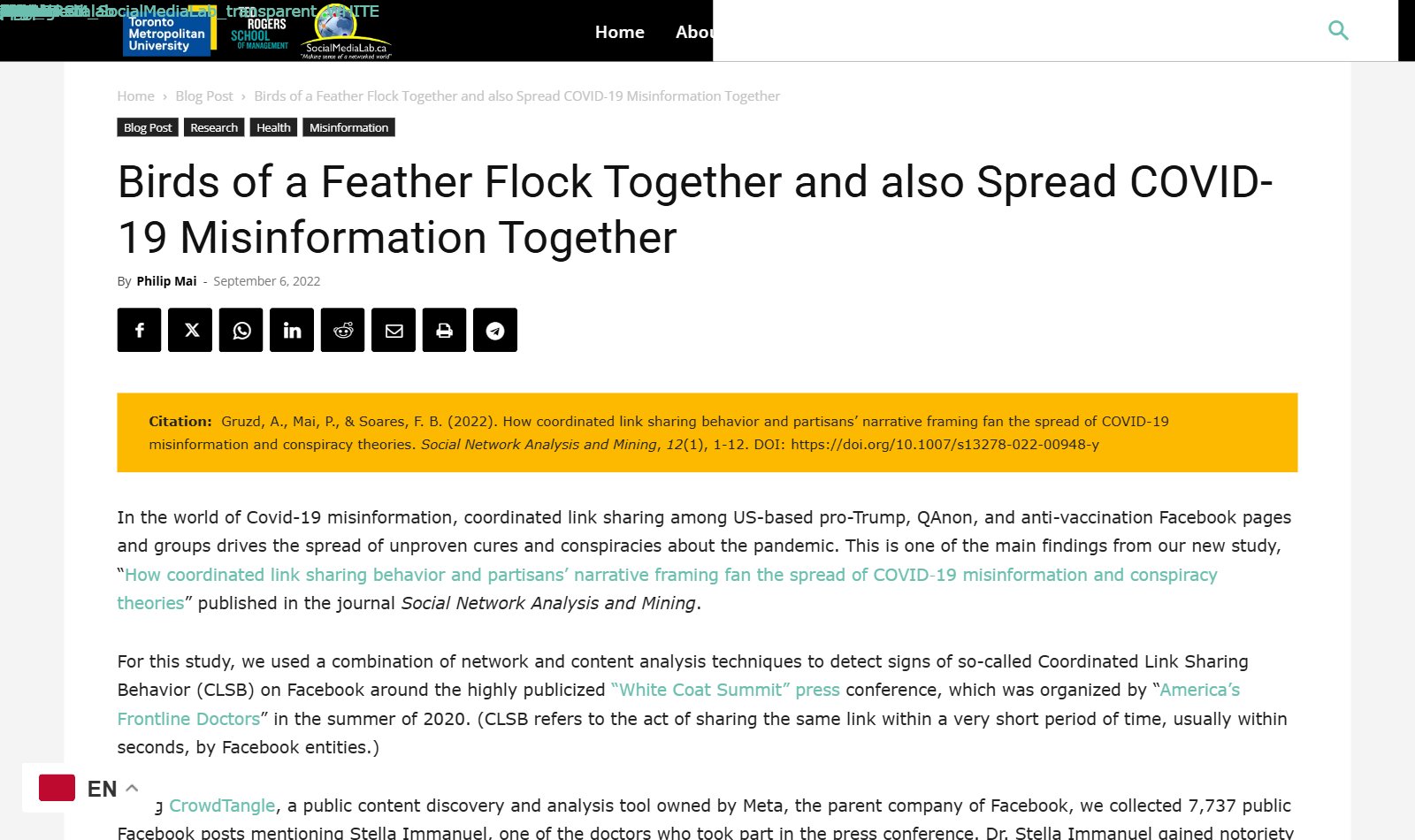
2. Coordinated link sharing (2022)
Gruzd, A., Mai, P., & Soares, F. B. (2022). How coordinated link sharing behavior and partisans’ narrative framing fan the spread of COVID-19 misinformation and conspiracy theories. Social Network Analysis and Mining, 12(1), 1–12. https://doi.org/10.1007/s13278-022-00948-y
What it found: Around the 2020 “White Coat Summit” press conference, pro-Trump, QAnon, and anti-vaccination Facebook pages and groups shared the same links within seconds of each other, helping push unproven cures and conspiracy theories.
How it connects: It comes from the same research program and uses the same large-scale data approach, this time on Facebook. That matters, because a Twitter-only archive can’t show how misinformation jumps between platforms.
3. “From Facebook to YouTube” (2023)
Gruzd, A., Abul-Fottouh, D., Song, M. Y., & Saiphoo, A. (2023). From Facebook to YouTube: The potential exposure to COVID-19 anti-vaccine videos on social media. Social Media + Society, 9(1). https://doi.org/10.1177/20563051221150403
What it found: 57% of the YouTube videos shared on Facebook in their sample were anti-vaccine. But YouTube’s related-video recommendations were no more likely to steer viewers toward anti-vaccine videos than toward pro-vaccine ones.
How it connects: Vaccine misinformation is the whole reason the archive has a separate vaccine file (see Methods). This study follows that same question onto other platforms.
4. “RIP Twitter API” (2024)
Murtfeldt, R., Paik, S., Alterman, N., Kahveci, I., & West, J. D. (2024). RIP Twitter API: A eulogy to its vast research contributions. arXiv. https://arxiv.org/abs/2404.07340
What it found: Research using Twitter data grew year after year until 2023. Once Twitter started charging for access, with enterprise access cited at $42,000 a month, the number of studies fell by 13%.
How it connects: It isn’t by the project team, but it describes this archive’s situation exactly. It explains why the tweet IDs are now so hard to use, and why archives collected before 2023 are worth so much.
The takeaway
What the research shows
The first three articles show the project producing real communication research with DH-style methods: big data collection, network analysis, and results shared in public. The fourth is the warning label. Research built on one platform’s data can vanish when that platform changes its mind.