The goal of the project is that it “attempts to document all police killings whether a fire arm is used or not.”
The primary audience for Mapping Police Violence seems to be researchers. Under the “Research and Resources” section, there is a statement that “we encourage continued scholarship using the Mapping Police Violence, Fatal Encounters, and the Washington Post Police Shooting databases.” There is also a second sentence that directly addresses those using the database for “independent research” to use multiple data sources. But this seems to be the only section that directly references who exactly the audience is. With the main audience being researchers, the main goal of Mapping Police Violence is for the continuation of research into police violence.
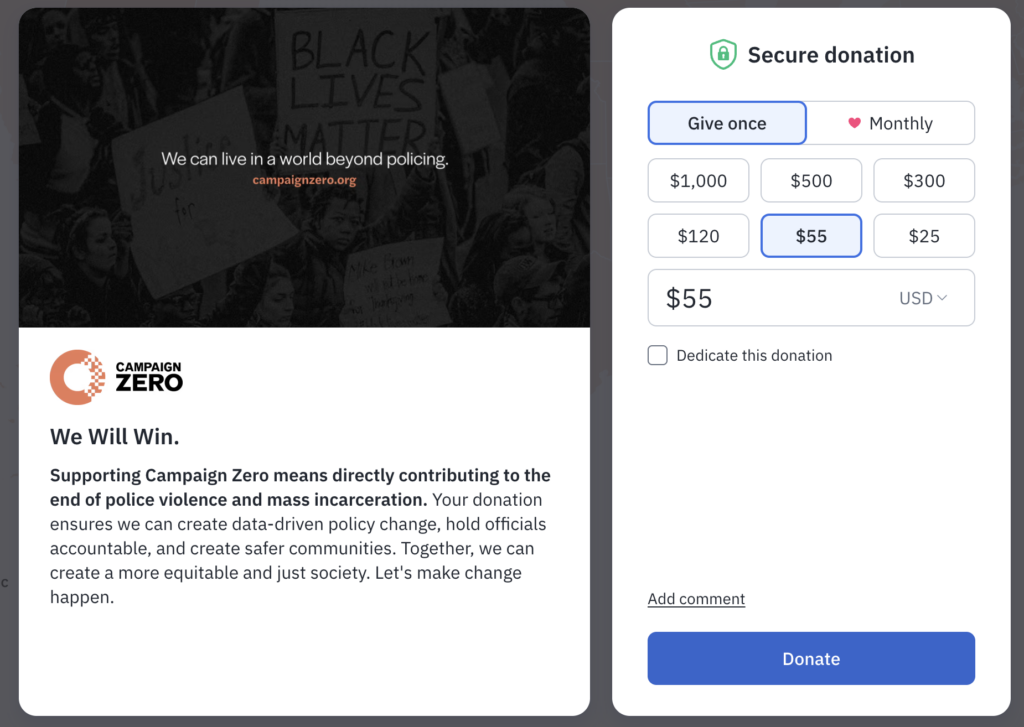
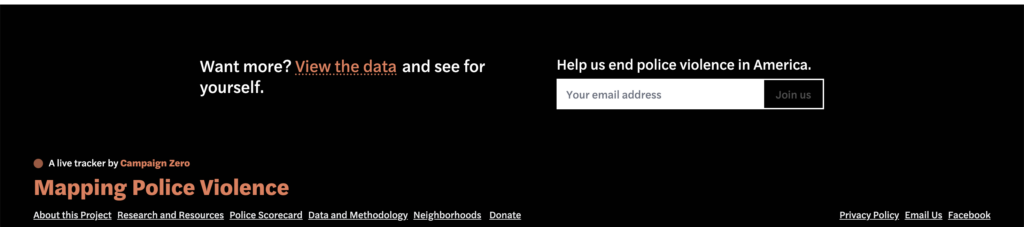
I think that there is also a secondary audience of those who are interested in supporting the protests against police violence. For these people, I think that the goal is more oriented to taking a more active role in the protest against police violence. Like how there is the option to donate to Camapign Zero on the Mapping Police Violence website and there is also the ability to stay updated by giving an email address.
I think that Mapping Police Violence does fit the best practices or digital humanities when it comes to having a research question. It does explicit state that the research goal of the project is about police violence and directly states it in the description of the project.
But it’s not directly stated exactly who the audience is for this project. Instead, it is more implied and I had to use information from the website in order to guess who the audience for the project would be. This goes against the best practices in digital humanities since according to best practices, the audience should be directly stated.