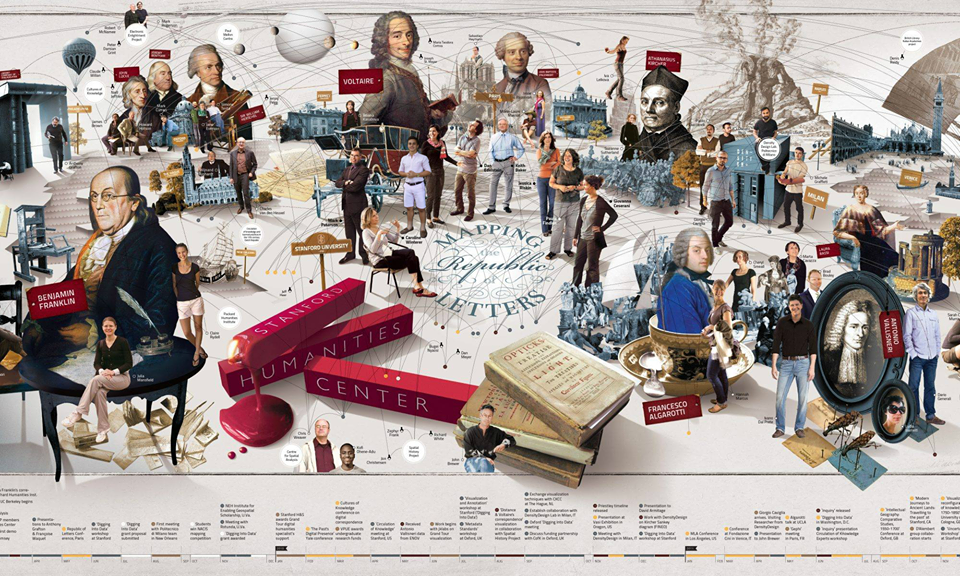
Project Effectivity
The first question that must be answered in reviewing Mapping the Republic of Letters is this: Does his project do what it set out to do? The answer is yes. Mapping the Republic of Letters desires to examine and, to quote from the Overview & Significance page, “depict correspondence networks across the globe, social networks of academies, and physical travel-based networks by using visualization tools that the user may interact with.” Mapping the Republic of Letters does do these things. This can be evidenced with the visualizations, data schemas, and data charts provided throughout the various case studies and publication contained within the project itself.
These visualizations and data representations, though, are not without fault–as is the whole project unto itself. While delivering on the goals in mind with which the creators of the project began, the way in which the information is delivered to the user has many flaws.
Shortcomings and Faults
Usability
Mapping the Republic of Letters is not a user-friendly website. Links throughout the project often lead to nowhere, instantly making the information and software tools used in the project that much harder to find and interact with, should one want to examine the project for their own benefits or recreate the processes in place. Faceted browsers are frequent within the various visualizations utilized throughout the case studies and publications of the project. These browsers are harder to use, especially for new users of the page. There are no instructions or research terms with which to differentiate data presented in the visualizations being looked at. Static images are present within aspects of the project, thus confusing the user even more. Data sets differ between case studies, making them impossible to compare to one another.
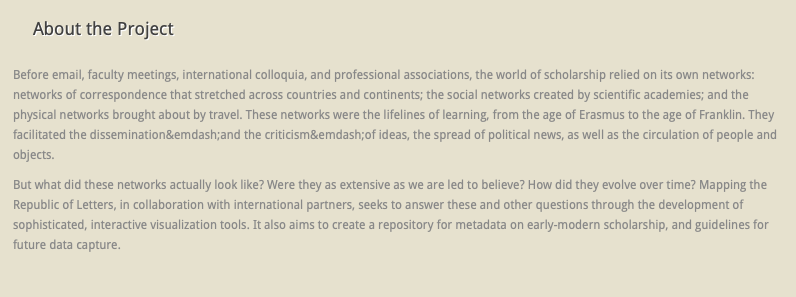
Along with these problems is the lack of a description of what the project itself is. The only description of what the project is about is located on the front page of the project, and it is severely lacking. Goals are explained and questions to be answered are stated, but there is no definitive answer as to what the project itself is, who was involved in the making of the project, or a description–however brief it may be–of the processes and tools which developed this project to the place that it is today. Users are immediately met with uncertainty to what it is they are looking at.
There is a profound confusion when exploring the project’s categories of study. It is perplexing as to what a case study is and what a publication is in the project. The short prefaces to said pages describe what each does and how they were created, but not what each item specifically is. Without a clear definition or differentiation between the two, Mapping the Republic of Letters puzzles their users as to the information they are examining, thus possibly destroying any semblance the user may have with which to create or recreate what the Mapping the Republic of Letters project has done.
Transparency
Mapping the Republic of Letters is not transparent in sharing their information or data, making their methodology that much more difficult to decipher. Almost everything goes without explanation; almost nothing is disclosed to the user. Crucial information and data are in the project, but the way that these things were collected, categorized, and analyzed is missing. Where does the data come from? Anyone that yearned to utilize the valuable information contained within Mapping the Republic of Letters is now completely lost. This, in turn, also completely alienates newcomers to the project. With difficulties in usability already evident, the frustration manifested from the dead ends within this project’s transparency would completely turn outsiders off.
Space, Place, and Location
Mapping the Republic of Letters utilizes the conventions of space, place, and location substantially well, which is of the utmost importance for a project of its nature. As previously stated on the Overview & Significance page,
Conclusion
In conclusion, Mapping the Republic of Letters is an insightful and necessary project for multiple individuals as well as disciplines. The project has valuable information that has been made available to the public to use at their own discretion and assists this information with various data schemas along with visualizations of said data. That being said, Mapping the Republic of Letters has major shortcomings and faults, as addressed above, regarding the usability of their project and the transparency of their processes. These flaws and their effect on the overall experience and functions of the project significantly decrease what the project could potentially offer.