Peers
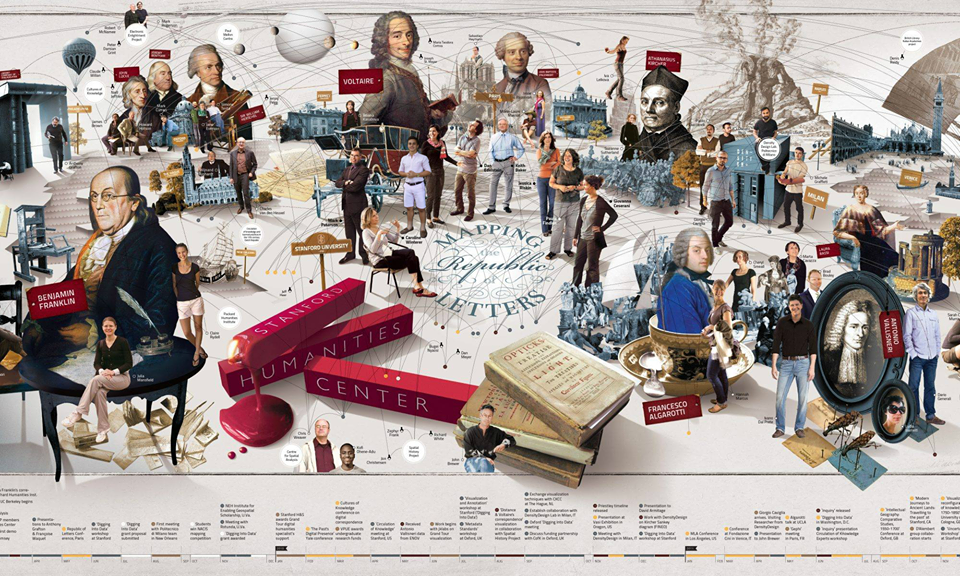
Several digital humanities projects share the goal of Mapping the Republic of Letters: visualizing the correspondence between famous early writers.
EMLO

Early Modern Letters Online (EMLO) catalogs correspondences from sixteenth-, seventeenth-, and eighteenth-century writers. EMLO was created in 2009 by Cultures of Knowledge, a research project based at the University of Oxford and funded by the Andrew W. Mellon Foundation. The site was developed by the Bodleian Digital Library Systems and Services (BDLSS). Researchers and repositories from across the world contribute to EMLO’s collection of correspondence data. Users can access dates, recipients, destinations and origins of letters and their authors. EMLO also features an editing tool called EMLO-edit, which allows contributors to manipulate metadata of the project. Both projects describe and visualize correspondences during the early modern era, but Mapping the Republic of Letters analyzes the implications of these correspondences, while EMLO approaches their data more quantitatively. Unlike Mapping the Republic of Letters, EMLO contains a database of letters from thousands of people and organizations. Mapping the Republic of Letters instead closely focuses on a handful of case studies. EMLO continues to grow its inventory of data, visualization features, and collaborators.
CKCC

Circulation of Knowledge and Learned Practices in the 17th-century Dutch Republic (CKCC) examines how knowledge was circulated during the scientific revolution in the 17th century. CKCC was created in 2009 and continues to expand. The project is a result of collaboration between Dutch researchers at the Descartes Center at University of Utrecht and Huygens ING, a research institute of the history of the Netherlands. The National Library of the Netherlands and the University of Amsterdam provided data, along with Huygens ING and the University of Utrecht. CKCC also collaborated internationally with Mapping the Republic of Letters and Cultures of Knowledge. CKCC represents its data using an application called ePistolarium, which was also developed by Huygens ING. Users can utilize its various visualization tools — graphs, network maps, geographic maps — to browse 20,000 letters sent to and from 17th century Dutch scholars. Mapping the Republic of Letters also employs various visualization types, but these differ with each scholar. CKCC’s data is located within one application, such that visualizations of correspondence data for each scholar can be compared side by side. The project is a valuable tool for historians and researchers to study how knowledge circulated in a time of astronomical, philosophical, and historical innovation.
Context
Not only do these projects share similarities to Mapping the Republic of Letters, but they were in collaboration with and directly influenced one another. Scholars from Stanford University’s Humanities Center, the Humanities and Bodleian Libraries of Oxford University, Groupe d’Alembert (CRNS), and members of the CKCC project shared data and methodologies across continents. EMLO, CKCC, and Mapping the Republic of Letters all began in 2009, so contributors were collaborating as the projects were still in development.
Projects similar to Mapping the Republic of Letters exist because they specify their interests. For example, CKCC focuses on correspondence from writers of the scientific revolution. Multiple projects also exist because they differ in methodology: EMLO imports its data to one central database and visualization tool, while Mapping the Republic of Letters performs analyses one case study at a time.