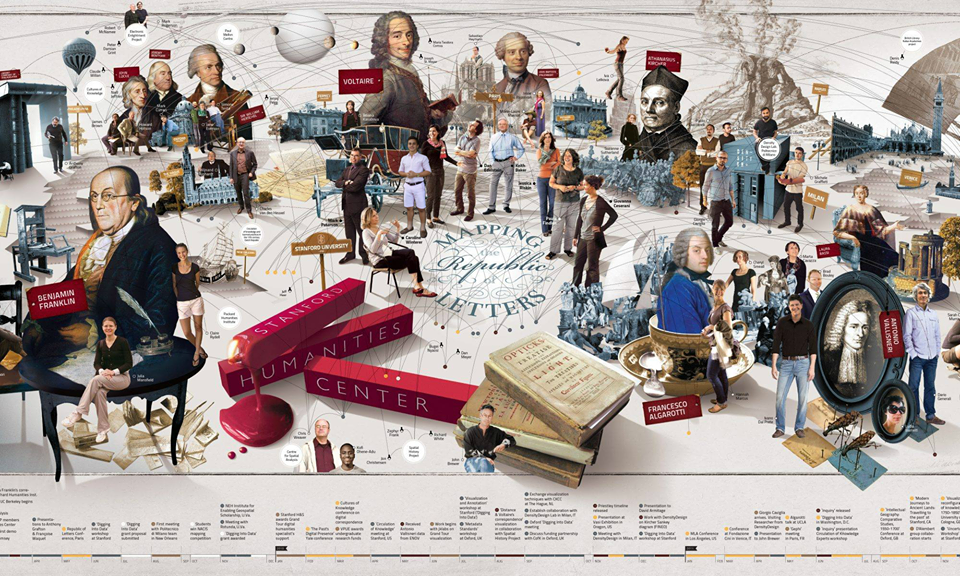
Audience
The target audience of Mapping the Republic of Letters centers on academics, historians, or those who are particularly interested in the correspondence of knowledge exchanged in late 17th and 18th centuries in Europe and the America, including the Age of Enlightenment. Students and other scholars are able to look at specific intellectuals and where their “letters” were sent or received. Educators and students alike are able to look at the exchange in a new light using visuals to see where hot-spot correspondences occurred.

Disciplines
Mapping the Republic of Letters has a team of individuals that specialize in various areas of study. These areas of study include History, Philosophy, etc. Having a host of backgrounds allows the project to accumulate and present data in various ways that pertain to each discipline. This diversifying of data attracts users of similar areas of study.
This project strongly appeals to those is the history fields, because Mapping the Republic of Letters consists of “making sense of patterns in large sets of heterogeneous historical data…”. This project contains some of histories great intellectuals, and pieces of their work. The mapping allows for historians to view correspondence in a new way, as well as where letters often overlapped between different intellectuals.
Philosophers would also take an interest in this project. The project contains a number of philosophers, including Locke, and Voltaire. This project allows for philosophers to examine the trading of views and other important information or ideas among some of the most known philosophers in history.
Literature, and political science would also be intrigued by the project. Every one of the case studies was conducted was done so because these intellectuals studied have impacted everyone, be it directly or indirectly. Much of their work has been the study of many students and scholars. Their involvement in politics throughout their lives appeals to current individuals who are in that field.

Looking at another point of view, data scientists would take a interest in this project because of the different visualizations pictured throughout different case studies. Among the case studies, the creators provided numerous ways to represent the data of how many letters were sent, written, and received (including locations sent to and from) by each of the intellectuals studied.
The creators of this project come from a history background (Paula Findlen, and Dan Edelstein) and digital research (Nicole Coleman). The combination of both allowed the project to embody historic exchanges of information, on an online platform. Seen through the unique visualizations, and the content of the case studies.