Communication Sciences and Disorders
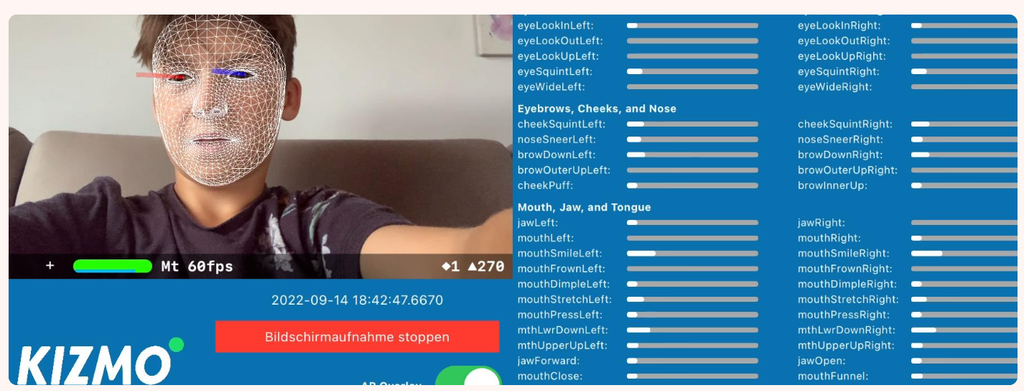
Communication Sciences and Disorders use many digital tools and research methods to study communication. The IDEAS research project demonstrates the use of digital tools through its partnership with KIZMO, a clinical innovation center for medical technology based in Oldenburg, Germany. KIZMO’s contribution to the IDEAS project focused on algorithms for relevant facial expressions, feasibility tests for facial expression analysis, and user-centered development.
Moreover, the facial recognition technology brought by KIZMO allows for the analysis of expressions and gestures. Using a camera from a laptop, the software recognizes over a thousand data points, which can be used to analyze facial movements and identify patterns in a person’s expressions and gestures.
Digital Humanities
In CSD, KIZMO’s facial-expression analysis helps researchers examine communication-related behaviors that may be relevant to autism screening. In Digital Humanities, similar digital methods can be used to analyze human behavior, communication, and cultural expression. Therefore, KIZMO’s use of facial-feature recognition and computational analysis in the IDEAS project provides a specific example of how digital tools can connect CSD with Digital Humanities.