The Salem Witch Trials: Documentary Archive and Transcription Project
The Salem Witch Trials: Documentary Archive and Transcription Project began in 1999 as a web based archive and database, and eventually expanded over the years to become a transcription project with the use of several important tools (for example, view shed analysis). The use of primary sources helps to document the Salem Witch Trials and colonial life in the late 1600s. The project was completed in 2002.
The original goal of the project was to collect, digitalize, and make primary sources on the Salem Witch Trials easily accessible to University of Virginia scholars, specifically The Salem Witchcraft Papers from 1977.
The SWP was a single-copy 3 volume publication of letters and other handwritten documents from the Salem Witch Trials era. Transcribing and digitizing them would allow the primary sources to be more understandable as well as accessible to anyone who may want to read them.
Once the main researcher had learned of his connection to Rebecca Nurse, a victim of the trials, his new goal was to enable as many voices as possible of the people involved to be heard.
This project was commemorated in 2017 by the city of Salem with a memorial.
The Salem Witch Trials Project Team
Benjamin Ray, at the time a graduate student and Religious Studies professor, as well as a Research Fellow for the Institute for Advanced Technology in the Humanities at The University of Virginia down the line, was the head of this project.
The original digitalization of the SWP was keyboarded by unnamed people in India.
Ray mainly collaborated with Professor Bernard Rosenthal, an English professor at SUNY Binghamton, who was previously working with a team of international scholars looking to transcribe court records from 1692-3 for a print publication. These manuscripts were held in several Boston and Salem archives
He also worked with a team of 4 unnamed scholars from various disciplines at the University to confirm the execution site location.
With grants from National Endowment for the Humanities (NEH), the American Academy of Religion, and the Institute of Advanced Technology in the Humanities (IATH), the project was able to develop further. IATH and founding director John Unsworth assisted by developing various search tools and digitizing new court records and several books.
Massachusetts Historical Society (MHS) gave permission to digitize their collection, which opened doors for the team to other Boston archives.
Images from the Project
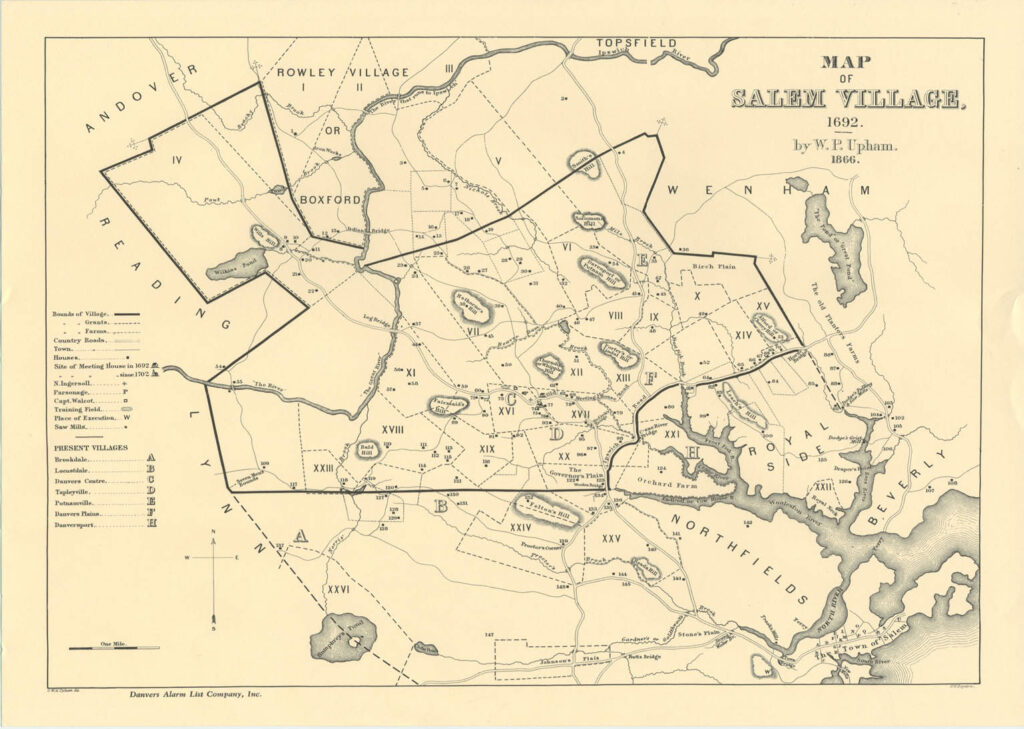
A map of Salem Village, 1692

Mary Walcott v. Susannah Martin court record
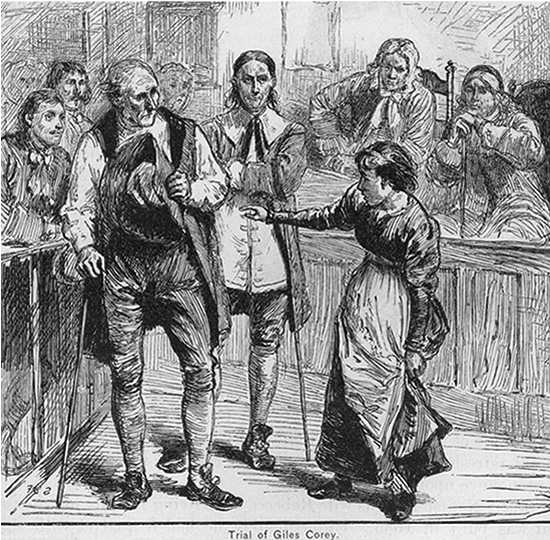
“Trial of Giles Corey” by Charles Stanley Reinhart
The Salem Witch Trials: An Introduction
The Salem Witch Trials is an example of a moral panic beginning in late February of 1692 through until the end of May 1693. Accusations of witches spread across 24 communities in eastern Massachusetts Bay Province, with Salem being the most well known. At least 200 people were accused, 30 were convicted, 19 were executed by hanging, 1 man was crushed to death with stones, and 5 more died in prison due to harsh conditions.