Walt Whitman Archive
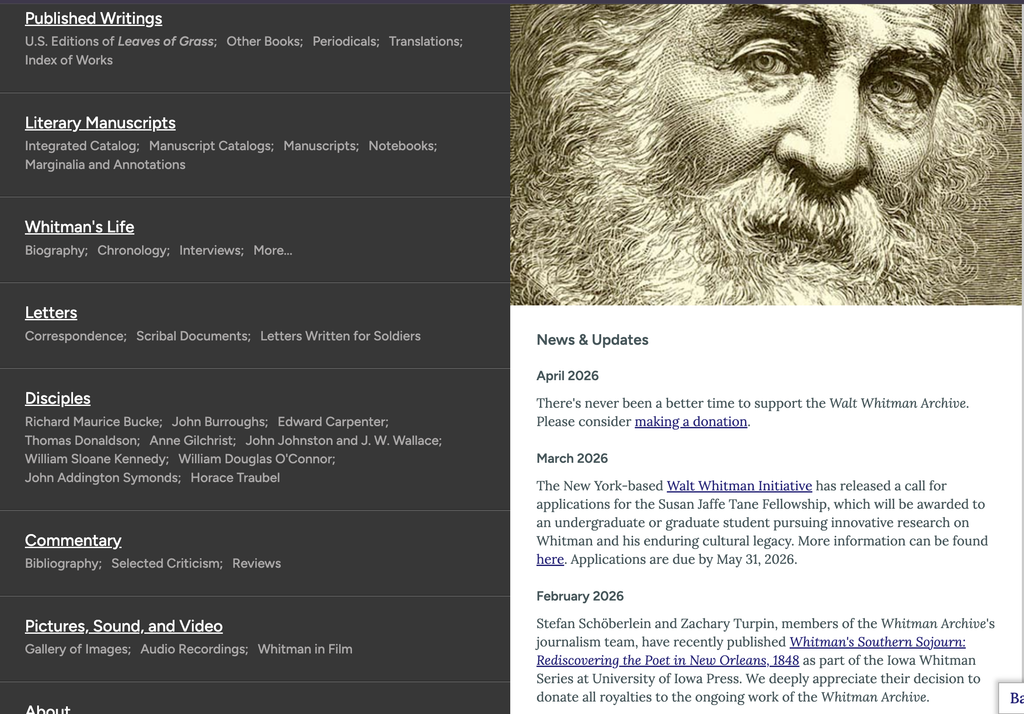
The Walt Whitman archive is a digital archive which includes his writings, manuscripts, pictures, films, and audio files. With this archive, we get to visualize Whitman’s life digitally with access to elements like recordings. Their goal is to make his works, and biography widely and easily accessible to scholars around the world. With access to things like pictures, audios, and manuscripts, it provides us with a visualization of Whitman, his work, and his life which better helps us understand literature. Without the digitalization, we would only have access to words on paper which is informative but limited. But with technology, we get a deeper understand of the meanings behind their works and a visual way to represent literature.
This project was directed by Matt Cohen (University of Nebraska–Lincoln), Kenneth M. Price (University of Nebraska–Lincoln), and Ed Folsom (University of Iowa), with ongoing contributions from many other editor-scholars, students, information professionals, and technologists. The archives main goal is to provide wide access to Whitman’s work and they believed that because Whitman’s work is always being revised, the constraints of a book does not capture its full essence. So they decided to start the project to fully represent Whitman and his work, and provide free world wide scholarly access.
They gained the information by researching libraries around the world, some were reluctant to share their rare collections but many believed that scanning the documents is an important way to preserve the culture. According to the project history Whitman’s manuscripts are scattered widely at over sixty different libraries. So the authors of the project gathered information from as many libraries as they could to provide Whitman’s manuscripts, old pictures, recordings, and different editions and revisions of his work. They hope that some of the prestigious libraries who hold Whitmans rare collections will eventually cooperate so everyone around the world can have access to great literature.
The Walt Whitman archive demonstrates how digital humanities works together with literature to share and preserve culture. While literature provides written formats of beliefs and culture, digital tools provides a way to make it widely accessible and preserve the culture. It also provides new ways to analyze literature by studying patterns, through recordings, pictures and more.