The People & The Program
To introduce the Renewing Inequality Project about Urban Renewal, Family Displacements, and Race from the 1950-1966 “. . . presents a newly comprehensive vantage point on mid-twentieth-century America: the expanding role of the federal government in the public and private redevelopment of cities and the perpetuation of racial and spatial inequalities. It offers the most comprehensive and unified set of national and local data on the federal Urban Renewal program, a World War II-era urban policy that fundamentally reshaped large and small cities well into the 1970s.”
Addressing Inequality
Raw displacement figures truly emphasize the inequality faced in relation to racial demographic data. Addressing the inequality consists of, “Scholars have long noted the violence of displacement that was often at the center of urban renewal projects. But by focusing their studies on larger cities, they have missed the preponderant story of the intimacy of racially-motivated clearance in smaller cities. By enabling users to view both raw displacement figures and displacement in terms of racial demographic data (drawn from the 1960 census), Renewing Inequality makes it possible to pinpoint the municipalities that displaced the highest percentage of their non-white or white populations.”

Who – Where – When
The Renewal Project began in 2018 and was developed by the Digital Scholarship Lab at the University of Richmond. This project is housed within the University of Richmond’s Digital Scholarship Lab and focuses on visualizing the impact of urban renewal policies on American cities. The renewal project is ongoing, and The Digital Scholarship Lab regularly updates and maintains its projects. The Renewing Inequality project at the University of Richmond is an ongoing digital scholarship initiative that continues to expand its dataset with information sourced from federal, state, and municipal reports.
Context & Goal
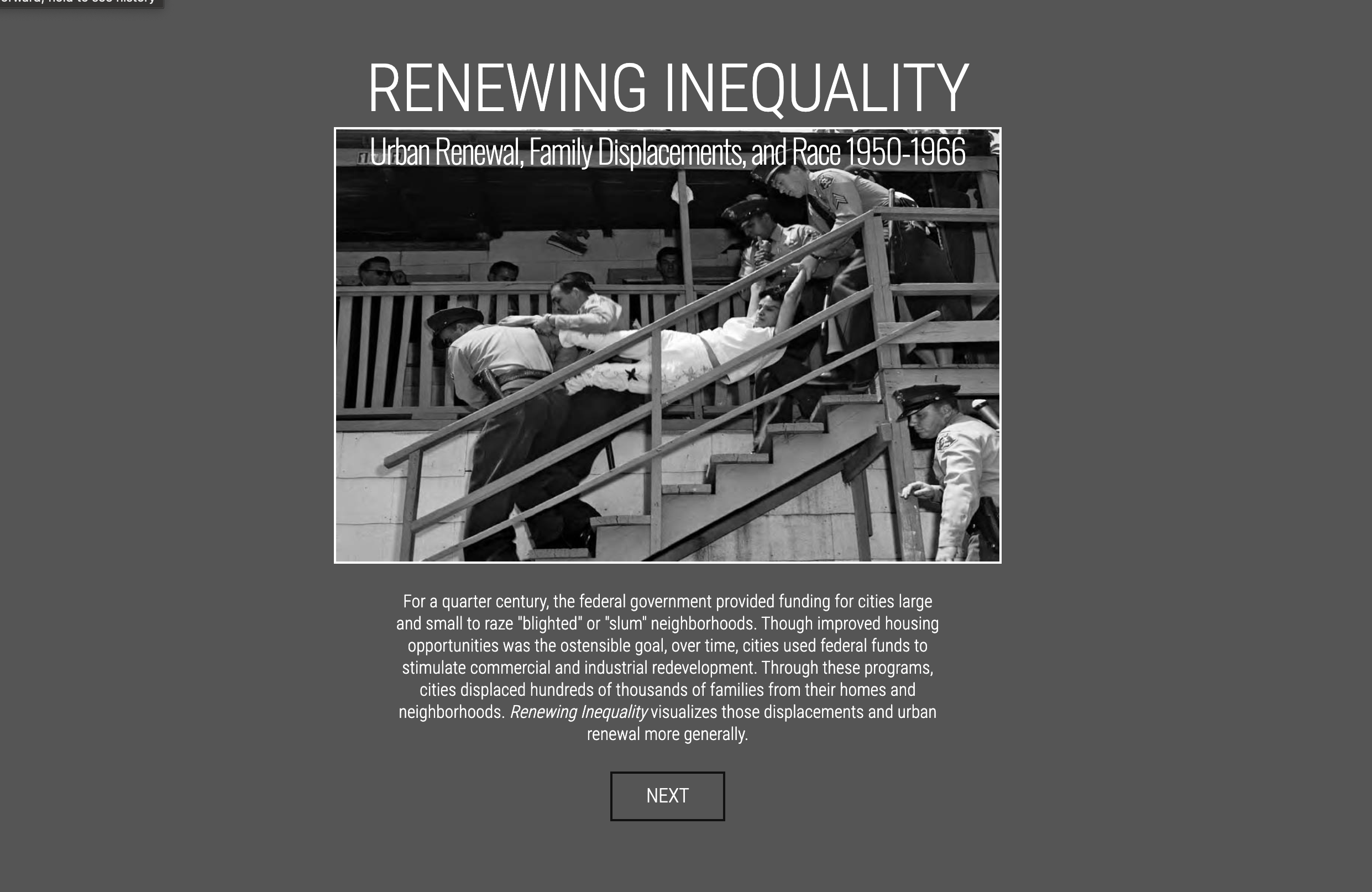
For a quarter century, the federal government provided funding for cities large and small to raze “blighted” or “slum” neighborhoods. Though improved housing opportunities was the ostensible goal, over time, cities used federal funds to stimulate commercial and industrial redevelopment. Through these programs, cities displaced hundreds of thousands of families from their homes and neighborhoods. Renewing Inequality visualizes those displacements and urban renewal more generally.
Digital Scholarship Lab, “Renewing Inequality,” American Panorama
, ed. Robert K. Nelson and Edward L. Ayers, accessed November 6, 2024, https://dsl.richmond.edu/panorama/renewal/#view=-684.03/-79/1.62&viz=cartogram&city=philadelphiaPA&loc=13/39.9508/-75.1675.