The Most Timeless Songs of All-Time uses many types of research to try to find a song that has withstood time. This project only uses data from Spotify play-counts and the Billboard Hot 100. This has made the data skewed which Matt Daniels, the editor of the project, points out right away.
“The data is skewed, since playcounts include people of all ages. Technically, we should normalize the data with Spotify users only born after 1995. They’re the incoming generation with little bias towards the music (they didn’t grow up with it), and they’ll influence whomever is around in 2050. Spotify’s user base already skews young, and the data more-or-less represents a generation in their mid-20s.”
-Matt Daniels
A note that Daniels did not make is that not everyone listens to Spotify. Just because the song is popular on Spotify does not mean its popular to everyone. When there are countless other music-based apps such as Pandora and Apple Music that people listen to, the data becomes skewed to only Spotify users.
The first piece of data that is shown is the most-played hits on Spotify from 1990-1999. This is a limited amount of data as it only shows music from one specific decade instead of looking at songs from at least a few decades. It would have been a more convincing resource if it had more options to sample from.
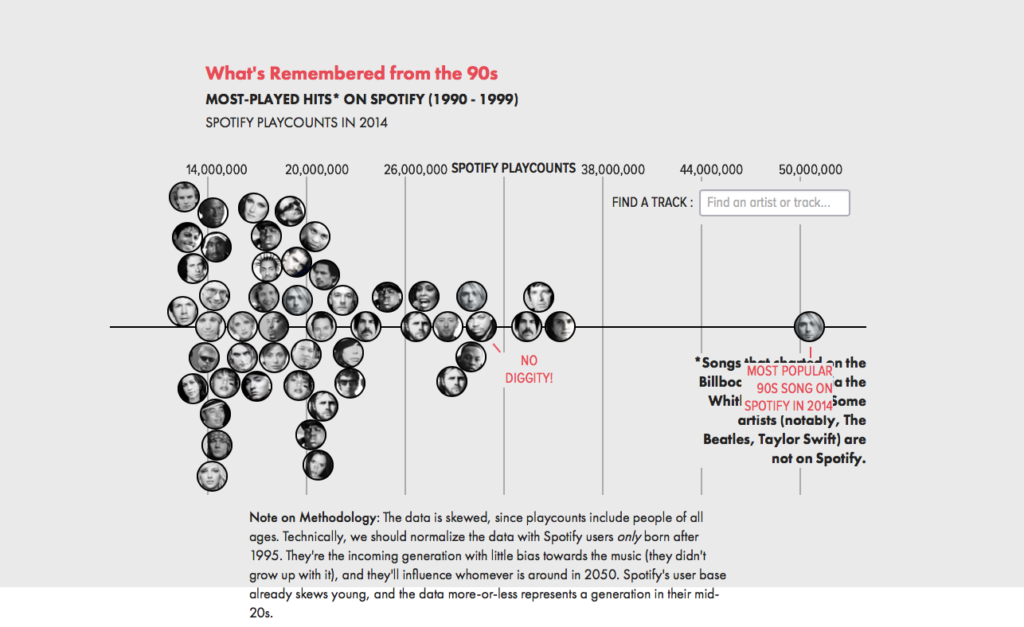
Although the graph is very easy to use, the amount of information within it is hard to find. It appears that only certain artists are shown while missing multiple top artists. Somehow Daniels forgot to add Pearl Jam! Pearl Jam has received multiple award like AMA’s, MTV Video Music Awards, and a Grammy. Most of their songs currently have over 50 million playcounts on Spotify. Daniels seemed to have used the method of “pick and choose” to determine what belongs on the graph.
This leads to another issue. Daniels does not explicitly say how he got his information. All the information that is provided is that the amount of Spotify play counts is used and the use of Billboard Hot 100. Other than that there is no process that Daniels explains. It could lead readers to believe that some of the information to could be false as the project is not transparent. How are readers supposed to know the methods if the information is not provided?
The next focus that Daniels look at was on the Most-Played Rap hits on Spotify from 1986-1999. This is just focusing on the genre instead of the overall grouping of music. This is the only graph that focuses on a specific genre which is also a little confusing. What is the point of adding one specific genre without focusing on, let’s say, the top 5 most popular genre of the past 50 years. It creates a skewed look at Daniels previous statement that No Diggity by Blackstreet is the most timeless song.
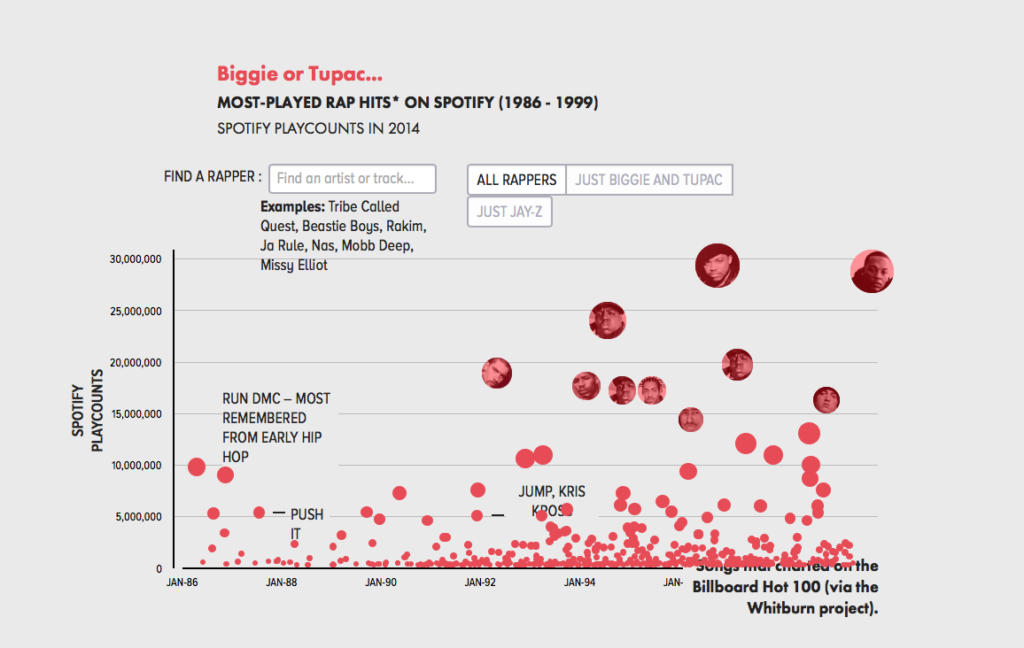
This graph is more accessible then the previous one. Users can search many more artists due to the more complete information provided.
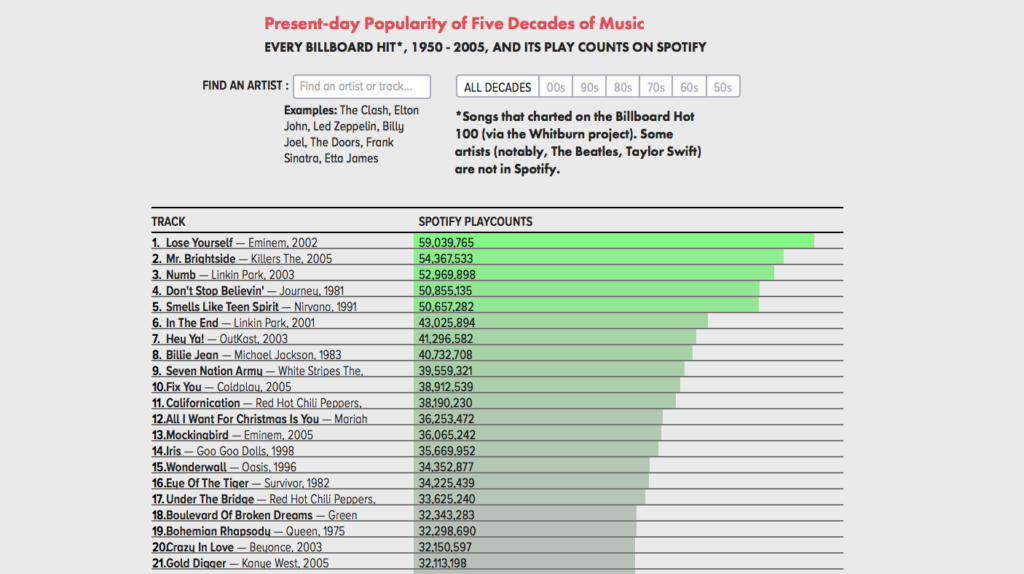
Daniels then focuses on Every Billboard hit that was released from 1950-2005 and then cross references them against the amount of play counts on Spotify. This graph is the most helpful as it uses a large sample – 55 years worth of music – and uses two separate resources. Users can expand the graph to show 1000 songs that were recorded on the Top 100.
Although, there are still some problems with this graph. One of the problems is that some of the Billboard Hot 100 are not included on Spotify. Songs are shuffled throughout the artist instead of being able to play a specific song. This also leads to more skewed information as Daniels can’t included all Billboard Hot 100 songs.
It’s important to note that the Billboard Hot 100 is bias. Billboard uses a compilation of sales, airplay, and streaming data to decide what is placed on the Hot 100. This would mean that artists who earn more money are more likely to be on the Hot 100.
“It is Billboard’s belief that assigning values to the levels of consumer engagement and access — along with the compensation derived from those options — better reflects the varied user activity occurring on these services”
–Billboard
On another note, the graph is very readable, showing when the song was released and how many Spotify play counts it has. Many different artists and artists are able to be searched in the search bar.
The next piece of information that Daniels focuses on is the Billboard performance vs the 2014 Spotify plays. This graph is the best way to show how songs are “timeless.” Through the option to look at certain decades, users can examine which songs have withstood time.
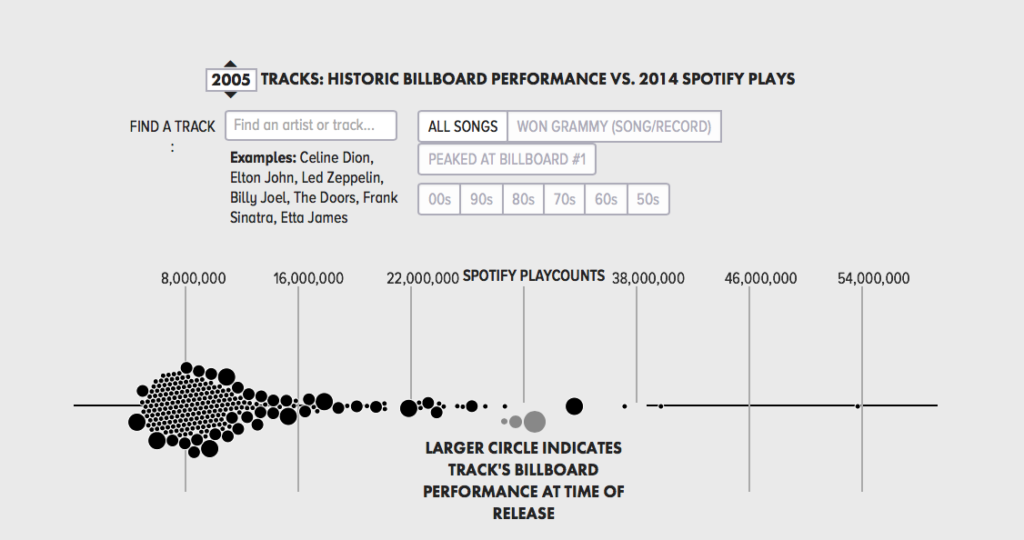
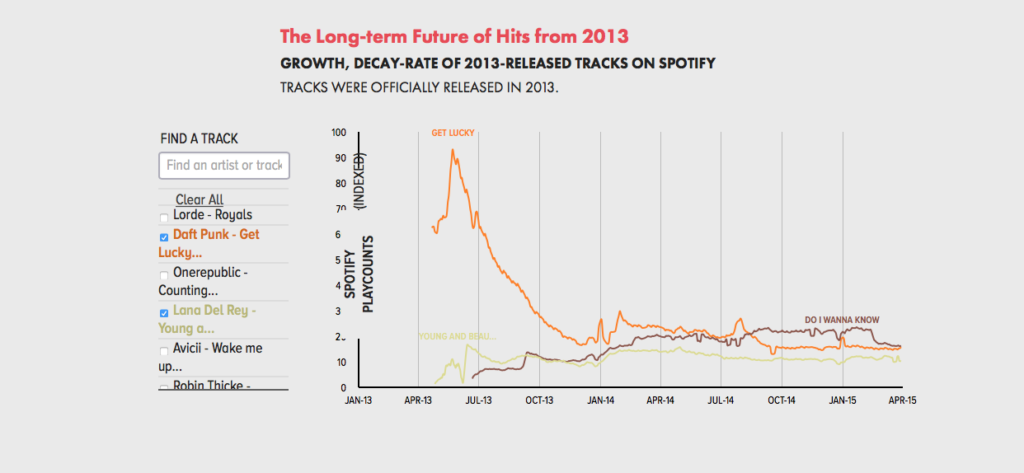
The last bit of information that is shown is the long-term look at the popularity of each song from the year 2013. This is once again a small sample and doesn’t give much information to the claim that No Diggity is the most timeless song.
Overall the research that was used in this project was vast as the amount of songs that had to be looked at was over the thousands. Although, the samples from many different time periods was not shown as much as it should have been. It’s hard to say with the research given if No Diggity is truly the most timeless song of all time.
