What’s on the Menu? is an ongoing project run by a diversely skilled team.
This project focuses on creating a public database of diverse menus.
Nearly every step of processing new menus is very transparent, from new entries to ones still under review.
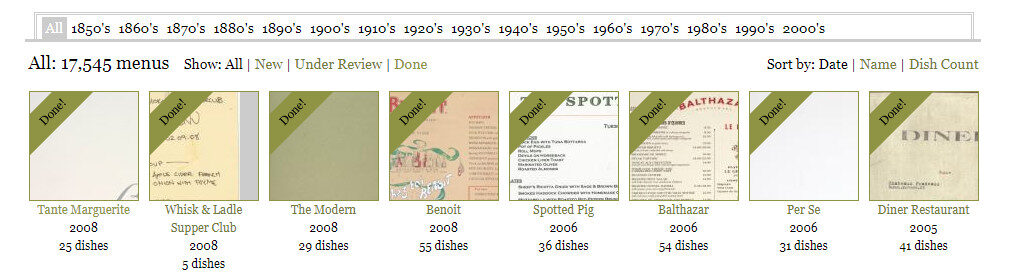
Some vital functions of the website are nonoperational at the time of this review, which drastically decreases its effectiveness in regards to visualizing the physical locations of the menus. The most critical of which is the geotagger tool that visualizes location data on a map. While this appears to be a relatively temporary outage, its absence hinders the functionality of the project’s aim.
Being partly volunteer oriented, What’s on the Menu? provides extensive transcription instruction and frequently asked questions to make the process work smoothly. There are multiple instances where the team links to a dedicated email for further assistance in the transcription process.
Completely transcribed menus clearly indicate the space, time, location, name, dishes, and similar information in a simple to navigate tag system. The database allowed for easy access to searches by dish, time, and other descriptors.
The blog is outdated, with new entries dating as old as 2013. A large number of links on the blog posts no longer work. On the main pages of the project website, all links worked as intended as of this review.

While the API hosted by the NYPL is experimental and a first for the library, information about the API and the database is not well labeled. In this, while the database and tools that created it are public, they are tailored more toward individuals that are more experienced in using these tools. Unlike the detailed transcription process, which supports ease of access for the general public, this same ease of access is not present toward information about the database itself or its API tools.