
THE MUSICAL DIVERSITY OF POP SONGS: A project created by Andrew Thompson and Matt Daniels; Illustrations by Damián Gaume
This project provides an analytical approach to the structure of hit songs and why they’ve topped the charts over the past few decades. Interactive graphs and charts offer an in-depth perspective regarding the repetitive nature of modern music creation, utilizing data from The Echo Nest.
The Breakdown
- The Purpose: Authenticity and individuality hold very little value when it comes to the modern hits, and distinctive sound has been traded in for what sells: “in short, originality has given way to homogeneity.”
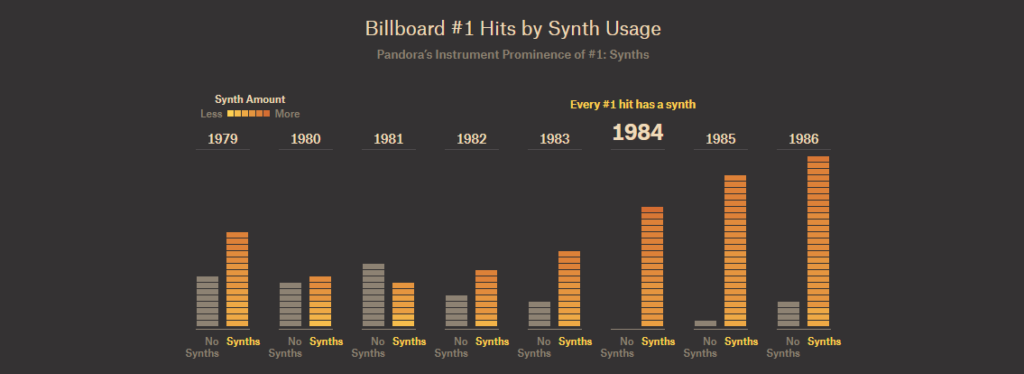
- Measuring the Similarity of Music: Was the music of the 80s any more diverse than today’s hits? Applying the method established by the Music Genome Project (breaking apart a song by its genre, vocals, tempo, key, and instruments) proves that though the hits of the 80s tended to employ similar instrumentation (looking at you, synthesizer), popular musicians tended to fall into distinctive idiosyncrasies.
- 8 Data Points: According to data pulled from Tristan Jehan’s company, The Echo Nest, trendy songs can be broken down into individual measures of eight key components that each contribute to the overall appeal:
- Valence– the measure of positive v. negative sound* and the emotions it invokes
- Energy– the degree of intensity and activity provoked by a song
- Speechiness– the number (if any) of spoken words in a track
- Liveness– the presence of a live audience in a recording**
- Loudness– the overall decibel level
- Acousticness– this determines whether a track is acoustic on a scale of confidence***
- Instrumentalness– the amounts of vocals v. instruments
- Danceability– the measure of a track’s suitability in a dance setting based on rhythm, tempo, etc.
- The authors then shared a comparison of hit songs throughout a period of 58 years- their conclusion? “Difference is trending downward.”
- Track and Hook: Music has devolved from an individualistic art form to a repetitive team production; from an average of 1-2 writers per song in the 1960s to at least 4 writers per song in the 2010s, with some songs even boasting a team of 10 or 11. “Musical quirks are averaged out” as modern songwriting strives to cater towards broader, shallower listener preferences.
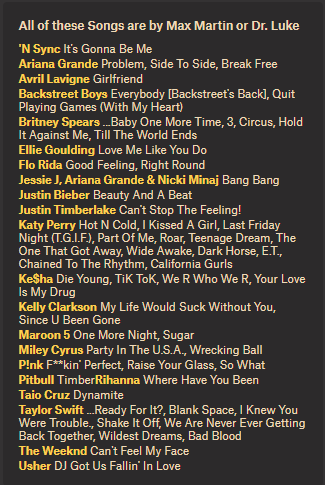
- The Top 1% of Music Creators: Recent software has taken the hard work out of music creation- but has it stripped it of its creative verve along the way? “Take a less personal production process and execute that process by a shrinking number of people… everything starts to sound more or less the same” In other words, musical similarity trends upwards as the number of popular producers decreases. However, in today’s media-driven culture, an uptick in the usage of music publication platforms such as Spotify and Soundcloud has streamlined the process of reaching millions; this trend could lead to the uprising of small-time creators as more opportunities are provided for individual artists to break through.
*No explanation is given as to what constitutes the emotion of a sound
**It is unclear whether a high level of “liveness” is considered positive when it comes to a song’s popularity
***However, “acoustic” is not defined, nor is it clear as how it is measured and whether a high level is positive
The Good, the Bad, and the Ugly
What went right?
– The integration of the song excerpts linked to each mentioned title keeps the reading groovy.
– Interesting facts scattered throughout (did you know that every #1 song of 1984 featured synthesizers?)
– Easy-to-use interactive charts create an active learning experience, and each sports a unique design and color scheme that makes them easy to distinguish and return to.
– Graphs and tables are kept simple and dictate clear results.
What needs improvement?
– When it comes to the “8 data point” research, the exact method of determination is a bit unclear- who decided that these were the most important aspects- and how? Are any components more or less important than the others? Unfortunately, the peer-reviewed method linked in this section was inaccessible.
