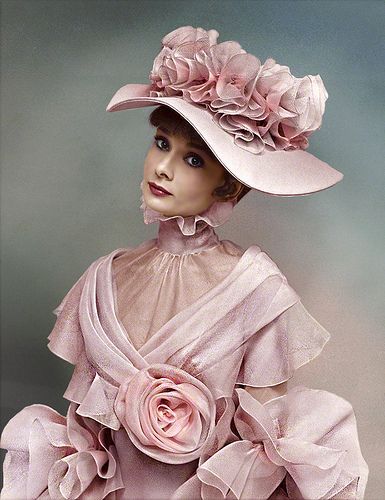
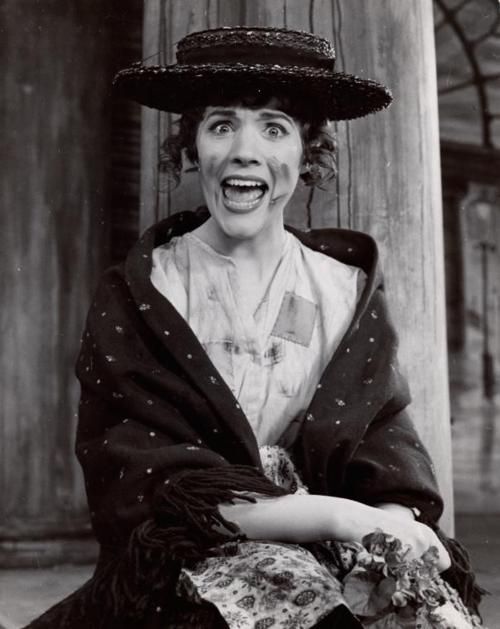

“Remember, Last night you not only danced with a Prince, but you behaved like a princess…” 4
The character of Eliza is interesting because she is “an abject woman who must be made-over to be embraced in the dominant social order” 7. Her very being in the play and her agency comes not from within herself, but from the persona that is given to her by professor Higgins. In this way, the character of Eliza in scene five, act two of My Fair Lady is a character of a woman who must perform in certain prescriptive ways, rather than just be Eliza. This is clearly seen when Eliza points out to Mrs. Higgins that “the difference between a lady and a flower girl is not how she behaves, but how she is treated” 4. In this way, Eliza is stating that nothing about her fundamental being has changed, rather her performance of her gender and how that relates to her status in society is the thing that has changed. “Certain deployments of gender, trouble gender by highlighting the disjunction between the sexed body and the performance, and thereby revealing the imitative nature of all gender identities and undermining their presumed metaphysical reality”5. It is certain that Butler would assert that Eliza has undergone an act of performativity to gain traction and social status from the high society members of the play, especially Professor Higgins. In fact, it is through Eliza’s performance in this scene that the audience can come to understand that “most of the norms that determine the behaviors of men and women, in fact, social gender construction have little or nothing to do with our bodily sexes” 8. What she says,and more importantly how she says it,should hold no baring on how she is perceived, and yet it does. She must correct herself when she makes mistakes such as “what I done” instead of “what I did” before she can hold any sense of standing with professor Higgins 4. These things make the chracter of Eliza the perfect example of Butler’s theory of performativity.

” Feminist theory has often been critical of naturalistic explanations of sex and sexuality that assume that the meaning of women’s social existence can be derived from some fact of their physiology” 3. Nothing about Eliza’s change from ‘flower girl’ to ‘lady’ has done anything to her physical being. Instead, this change is visible in the actions and thoughts of Eliza and is therefore undeniable proof that her concept of her gender is inherently performative. It is easy to see this gender performativity and is also essential that it exists for this scene to hold gravity for the audience. Eliza’s performative nature is the reason why the conflict between herself and Higgins occurs and without her gender and agency in that gender, this scene would hold no weight. It is because Eliza is “now a lady” that the audience cares about her, as well as Higgins. Her transformation is highlighted in the scene so that the audience may understand that it was merely superficial. Eliza had all of these thoughts in her before, yet she had not platform in which to be expressed and heard until now. It is because of this also that the audience can understand her performance of gender and realize that it has nothing to do with Eliza’s feelings.