Digital Humanities and International Business Goals
What is the goal of The Atlas of Economic Complexity?
The goal of the Atlas of Economic Complexity is to help people understand how countries trade, grow, and develop over time. It brings together global trade data and presents it through interactive charts and maps that make economic relationships easier to recognize. By focusing on a country’s industries and productive capabilities, the Atlas shows how present strengths influence future growth. Through this approach, policymakers, researchers, and businesses can better interpret global economic trends and make informed decisions.
This connects to Digital Humanities because both fields use digital platforms to examine complex systems and uncover meaningful patterns within large bodies of information.
Understanding Countries
- The Atlas focuses on what countries produce and export to explain how economies develop.
- It shows how a country’s industries and skills influence its future opportunities.
- This deeper understanding supports responsible planning and global engagement.

“Geographic network flow map (i.e., trade data on world map)” from Holoviz Discourse, https://discourse.holoviz.org/t/geographic-network-flow-map-ie-trade-data-on-world-map/4265
Similarly, Digital Humanities seeks to understand societies by examining patterns in cultural and historical data. Both disciplines aim to interpret complex systems in ways that lead to greater knowledge and insight.
Built Data Visualizations
- The Atlas creates interactive visualizations instead of static tables of numbers.
- Treemaps and charts allow users to explore economic relationships themselves.
- Clear visuals make complicated information easier to interpret.
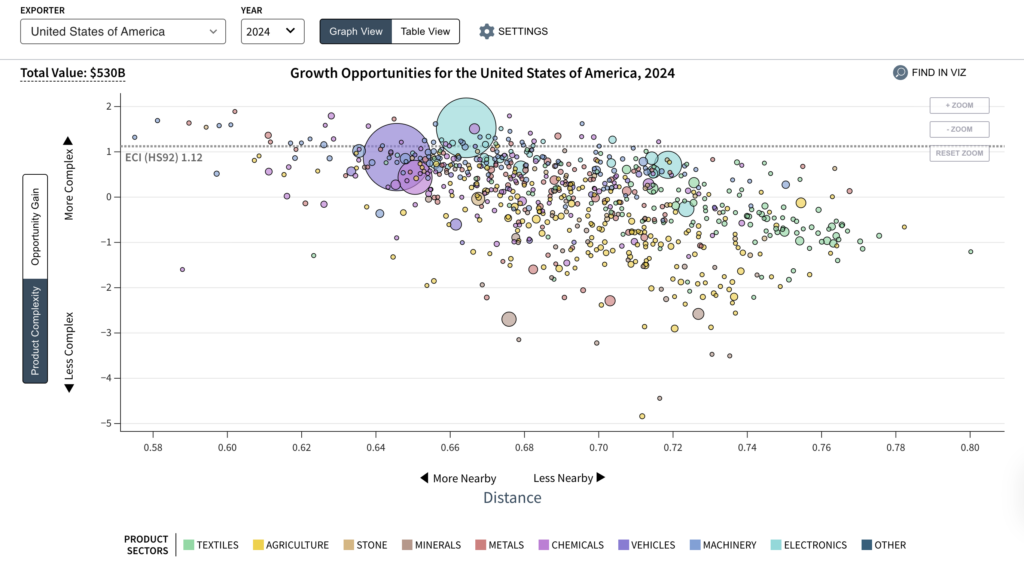
Growth Opportunities for the United States of America, 2024. Atlas of Economic Complexity, Harvard Growth Lab, Harvard Kennedy School, https://atlas.hks.harvard.edu/explore/feasibility?year=2024&exporter=country-840
Digital Humanities shares this emphasis on thoughtful presentation. DH projects also design digital tools that invite users to interact with research materials, strengthening understanding through visual interpretation.
Alignment with Digital Humanities
Overall, the goals of the Atlas align with Digital Humanities because both prioritize interpretation, accessibility, and engagement. While the Atlas focuses on economic systems and DH often centers on cultural systems, each field uses digital methods to clarify complexity and support deeper understanding. Their shared commitment to presenting information in meaningful and interactive ways demonstrates strong interdisciplinary compatibility.