Harvard Growth Lab Research Platform
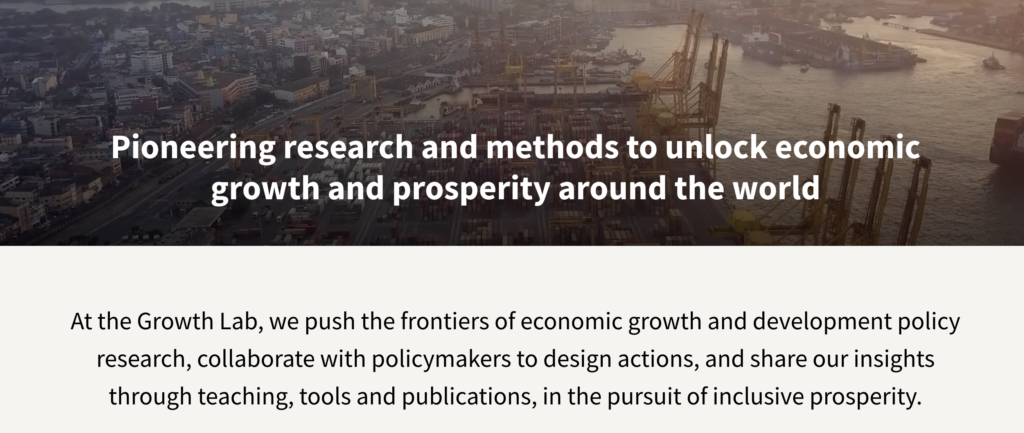
The Harvard Growth Lab is a research group at Harvard University that studies how and why countries grow economically. It collects large amounts of global trade and industry data and turns that information into interactive visual tools that people can explore online. Instead of reading complicated spreadsheets, users can see economic patterns displayed in charts, maps, and treemaps that make trends easier to understand. The Growth Lab’s tools help researchers, policymakers, and businesses identify strengths, weaknesses, and new growth opportunities within different economies. In International Business, similar data analysis tools are used to study global markets and guide decision-making. Like Digital Humanities projects that use digital platforms to interpret complex cultural data, the Growth Lab uses digital tools to make complex economic information clearer and more accessible.
Harvard Growth Lab. Harvard Kennedy School, https://growthlab.hks.harvard.edu/
FRED ( Federal Reserve Economic Data)
FRED, which stands for Federal Reserve Economic Data, is an online database created by the Federal Reserve Bank of St. Louis. It collects and organizes economic information such as inflation rates, employment numbers, trade data, and other financial indicators. Instead of reading long reports filled with numbers, users can view this information through clear graphs and charts. In the Atlas of Economic Complexity, data adjusted using FRED helps ensure that economic comparisons between countries are accurate and consistent over time. In simple terms, FRED acts like a trusted library of economic statistics that researchers and policymakers can use to better understand how economies are changing. Both International Business and Digital Humanities rely on structured data systems like FRED to analyze patterns and make informed decisions.
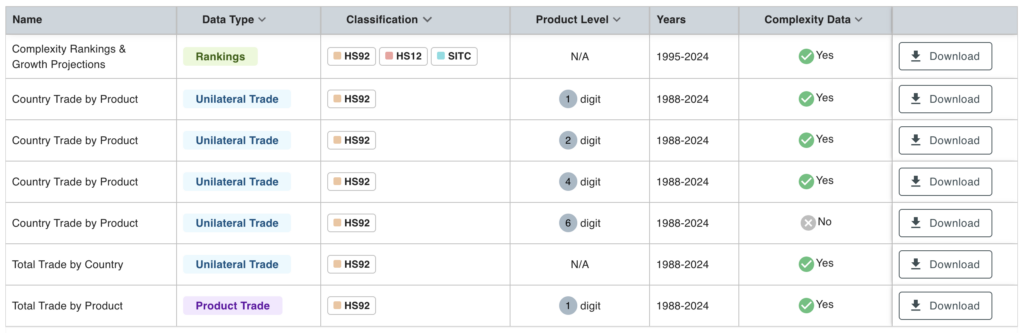
Atlas Data Downloads. Atlas of Economic Complexity, Harvard Growth Lab, https://atlas.hks.harvard.edu/data-downloads
Summary
Both the Harvard Growth Lab and FRED can be used in Digital Humanities because they help people understand large amounts of information in clear and organized ways. The Harvard Growth Lab takes complicated global economic data and turns it into interactive charts and maps that make patterns easier to see. FRED works like a trusted online library of economic statistics, organizing numbers into simple graphs so users can understand changes over time. Even though these tools focus on economic data, the way they work, collecting information, organizing it, and showing it visually, is very similar to how Digital Humanities projects study culture, history, and society using digital tools. In simple terms, both platforms use technology to make complex information easier to explore and understand, which fits well within Digital Humanities research.