Exploring the Intersection of Musicology and Digital Humanities
My name is Quinn Adams, and I a college student at West Chester University studying under Professor Cream for my Intro to Digital Humanities course. This page is a collection of my own work directed at investigating the link between Digital Humanities and Musicology, and references the Linked Jazz Project as well as a publication by Albrecht Schneider to determine the compatibility of Digital Humanities and Musicology.
For the uninitiated: Musicology is the academic research based approach to studying music, consolidating and drawing from many fields such as psychology, sociology, acoustics, neurology, natural sciences, formal sciences, and computer science. In this page, we will look at the many ways digital art humanities are already being utilized within the field, how well these fields mesh, and how we can further incorporate digital tools to improve our understanding of the field.
Useful links on understanding musicology
Music History
While technically a widely encompassing field with regards to culture and time period, music history in the academic space has held its focus on Europe from the early Medieval to the present, as well as America (often seen and treated as an extension of European influences and practices). This is due in part to the large pool of data collected through physical transcripts that have been retrieved, though a sense of European/western superiority with respect to music cannot be overlooked. As the world becomes increasingly more interconnected, the field is beginning to broaden in its scope; communication between academics across continents is rapidly allowing us to create larger and more comprehensive databases, providing us a better overview of our musical history as a species.

Ethnomusicology
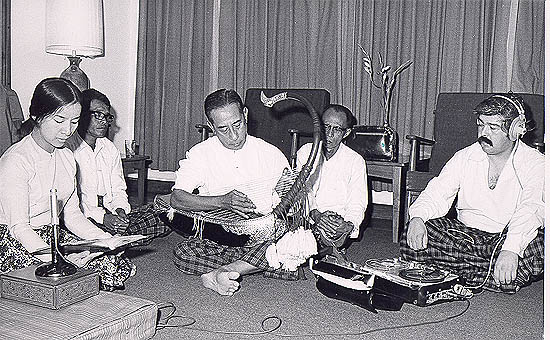
As ethnomusicology has a focus on music from other cultures, it is sometimes misrepresented as a study of musical histories from non-western societies. This is a simplification, ignoring the large focus on how different cultures and peoples perceive and value music, how it shapes religion and customs, and the myriad of notations, orchestration, and instrumentation found throughout the world. The first and most controversial way that digital technology found its path in ethnomusicology was the recording of various indigenous sounds, notably those of the Aborigines, which was catalogued for posterity before its inevitable marketization. The line between studying and profiting off the discipline is a fine one, and scholars are continuously looking for constructive and non-appropriating ways to study and learn about remote and unseen musical cultures.
Digital Humanities
The Digital Humanities permeate through so many different fields of study that it can often be hard to differentiate what does or doesn’t fall under its umbrella. In short, however, Digital Humanities is a field of study dedicated to the use and application of computational tools and processes within humanitarian fields such as literature, history, and philosophy.

The Linked Jazz Project
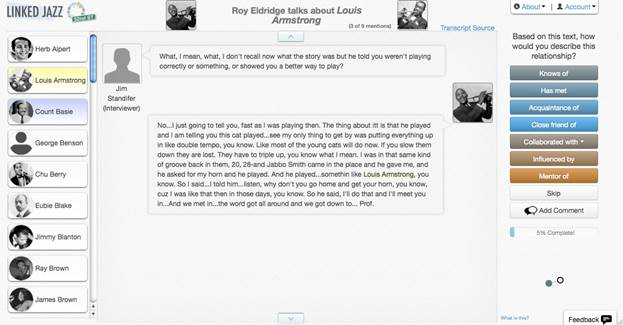
Founded in 2011 under the semantic lab at Pratt, Linked Jazz is the brainchild of Cristina Pattuelli that aims to visualize via networks relationships between musicians, instruments, genres and works through Linked Data. The project was built using 50+ transcripts, and through “[experimentation] with the actual content of interview transcripts, [they generated] new triples based on data rather than converting existing metadata.” In other words, they were able to glean objective datapoints from interviews, rather than having to rely on subjective assessments of the interviews. The website is forever a work in progress, with the creators looking to further the purview of the dataset by integrating the jazz archives of Carnegie Hall and Tulane University. Moreover, the project was developed somewhat as a prototype, and serves as a proof of concept for the use of the technology in musicology.
Linked jazz is the perfect example of a meeting between musicology, specifically the study of American Jazz, and Digital Humanities, compiling an extensive network of connections between various jazz musicians based on who they played with the most. In doing so, researchers can strive to find a more objective method of examining how musicians influence each other through collaboration and performance. Until now, determining how influence was and is made was an entirely subjective process, relying on personal testaments from players and third party analysis of improvisational, stylistic, and compositional choices, followed by rigorous cross-referencing. With networks like Linked Jazz, we can streamline the research process through the addition of this easily understood and frankly intuitive resource.
The connections between performers and their relative “strength” are depicted by line thickness, and show every interaction documented within the original dataset. These connections are further adjusted using the 52nd Street Crowdsourcing tool, where human input can be given through an interactive webtool, and is reflected in the network when verified against other’s inputs.
Comparative and Systematic Musicology in Relation to Ethnomusicology: A Historical and Methodological Survey
Schneider, A. (2006). Comparative and systematic musicology in relation to ethnomusicology: A historical and methodological survey. Ethnomusicology, 50(2), 236–258. https://doi.org/10.2307/20174451
In Schneider’s exhaustive overview of Comparative and Systematic Musicology, he brings up many issues relating to the incommensurable nature of musicology as a study cross-culturally. In order to understand and document musical practices in foreign cultures, a researcher is limited by their own perspective and relationship with music, often missing the mark when it comes to accurately portraying the system and function of music in a given culture. Arguments can be made that research should be done internally, i.e. by scholars with personal connections to the study, though such a doctrine would only inhibit the progress of the field, both in terms of academic growth and wider attention. Schneider describes the many true parallels that can be found across all cultures, such as the presence of an observed octave
(relating to observed pitch chroma), which suggests that there are fundamental musical values based on our human biology, unrelated to aesthetics and taste. Finding these parallels can prove to be quite difficult however, as defining basic musical archetypes is a beast in of itself. Various mathematical formulas can be applied, though by hand, which often look into perceived melodic lines, and aim to find connections or similarities between them within individual cultures, as well as transversely. As transcription machines become more sophisticated, the possibility of using computers to cross-reference compiled data sets and recordings would open the door to finding and labeling universal “musical corp[i].”
Digital tools
Gephi – The Open Graph
dwadawd
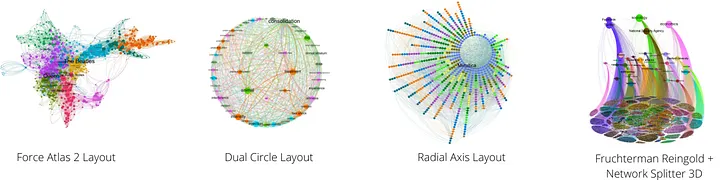
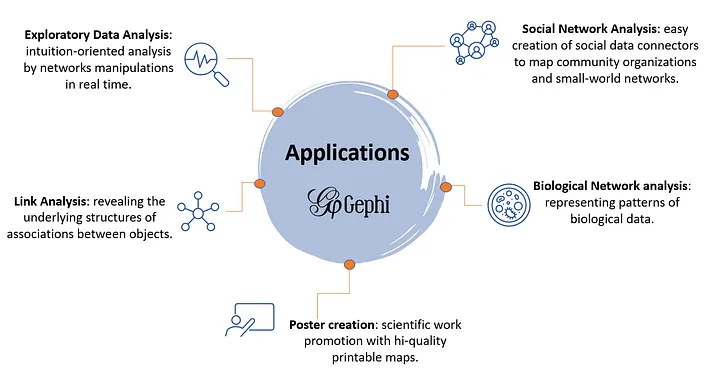
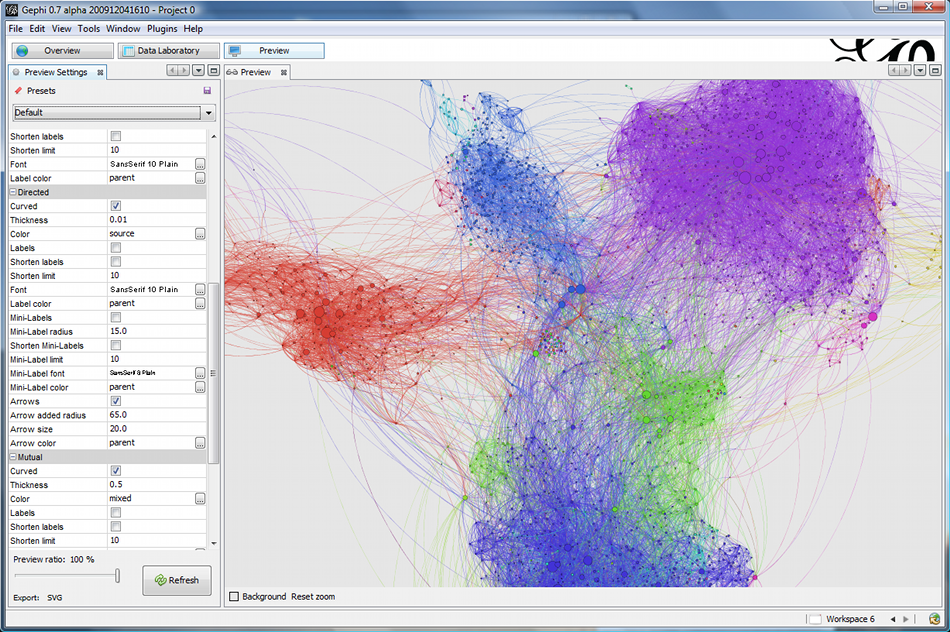
Gephi is an open source, free to use, network-graphing program that has applications across a plethora of subjects, and specializes in showing the relationships between entities within broader contexts by using spatial location, size of entities, thickness of connections, color coding, and more, thus making it easier to develop hypotheses as a researcher. The tool itself is incredibly customizable, and can even show changes to the connections over periods of time by adding new dimensions to the graph. The tool relies heavily upon its strong communal support, and links many guides and explanations from within the online community on how to customize the parameters in order to display your data in the best possible way.
One of the strengths of Gephi is that it is exported as a Gephi file, meaning that websites that use Gephi networks can easily share the data with users, something that directly aligns with the open source goal of Gephi.

Goals
Linked Jazz
As listed on their website, the goals of Linked Jazz are:
- To uncover meaningful connections between documents and data related to the personal and professional lives of jazz artists, and
- To develop broadly applicable tools and methods for working with Linked Open Data.
I believe that these goals perfectly align with the goals of digital humanities, as they both 1) seek to use digital tools as a method of interpreting data or information in new and insightful ways, and 2) search to expand the domain in which these tools are used.
Taking a look at Schneider’s Publications, we can see the author’s main goal in publishing the work is:
- To bring awareness to the inherently flawed nature of ethnomusicology with respect to how data is collected and reviewed
If we view this through a digital humanities lens, we can see that the issue presented in the publication may very well have solutions to be found through the intersection of digital humanities and ethnomusicology. The primary issue raised is how humans compare and contrast the data, specifically the biased framework they operate within; hence, using digitalized methods of examining and categorizing data can be the first step in removing this bias.

Values of Digital Humanities
The Linked Jazz project centers itself on the oral history of jazz through interviews, and highly values diversity and inclusion throughout its work, particularly uplifting and recognizing women in Jazz through the program. I believe that the Digital Humanities values and ideals perfectly align with this intent, as the digitalization of information allows for more visibility across the board for person’s of interest. More specifically, the greater number of people and compositions there are recorded and accessible to the public, the easier it becomes to highlight and support the more marginalized and typically whitewashed accounts.
Historamuse
Finally, Does it Comport?
On a semi-numerical basis, I have determined that the Digital Humanities (DH) and Musicology are not only compatible, but also complimentary due to the congruency of their goals and values. As discussed prior, DH is a way to introduce objectivity into typically subjective spaces, something that the world of ethnomusicology is especially in need of. Secondly, DH is able to uncover peoples and stories, that would otherwise stay hidden in a sea of text, by making information more accessible to the public. DH can also achieve this visibility by condensing information from a wide spectrum of sources into a singular page, all in an easy-to-interact-with manner.
All in all, DH is a great benefit to the world of musicology, and the two studies will assuredly grow closer as time progresses.