One value that is shown throughout the course of the project is transparency with the audience. The team is fairly open with their process and where their data comes from and how they transform it into what they do.
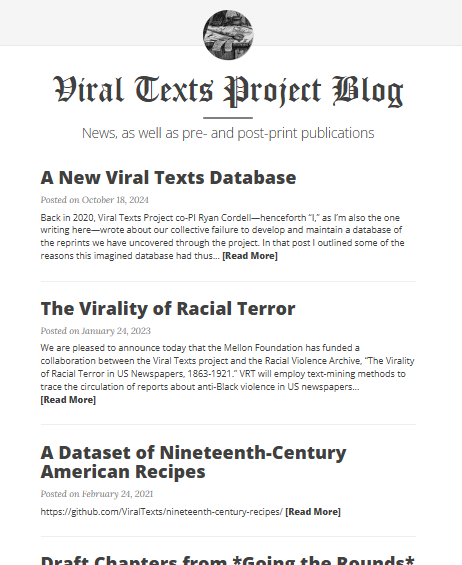
As already stated in previous pages, they explain pretty openly the places they get their data from, that being Chronicling America, Making of America, Trove, Europeana, and Internet Archive. And they make their data and tools open through their database with the text clusters and their GitHub page with more data and the repository for passim for other people to use it for their own analysis of text reuse. Furthermore, they even share things like their process and even their failures in the project through their blog posts that they have available on their website. And although they don’t explain everything in detail as discussed previously, such as what exactly passim does, there are ways still to understand what was done or how something worked.
Another key value that the team embraces is their experimentation with ideas and building this project to be better, and even though it isn’t mentioned directly it is implied a lot. A big indicator of this is when Ryan Cordell talked about the failures of the project in one of his blog posts in 2020, in which he describes how they had tried, but ultimately hadn’t been able to make the database seven years after the project started. It is a really interesting read, but he uses the post to ultimately embrace the failures of the team and use it to reflect on how the project has evolved through their different tests. With one of their biggest failures at the time being the fact that they only had a CSV file of data to go through, which Cordell claims that if someone came across it, they would have no idea how to sift through the information there and become overwhelmed, so it meant that their data wasn’t accessible for most people, which is the opposite of what the team wanted. But it is why they kept experimenting through trial and error before they were able to finally release their database to the public in 2024, so they could everything more accessible to the average person even if they had minimal tech knowledge.
Connection to DH
Transparency is key in Digital Humanities because it illustrates that you are being fully open with the audience in how you have achieved what you have in a project. In which things are well documented and it is stated where data came from and how it was transformed, failures and successes that have been faced, and who did what in the project. As discussed, the Viral Texts project covers all of these marks and has a fairly strong documentation to illustrate both the foundation of the project and allowing people to see the data for themselves. However, there are definitely some aspects that could be improve upon in their documentation like how things like their passim algorithm works and even a bit more explicit steps for how they did certain things could be helpful for audiences to understand what they have done and how they did it.
Experimentation is another key value in Digital Humanities because it allows for innovation when facing more complex topics. Since DH is an interdisciplinary field it means that it does anything it can to connect humanities and technology together, and in doing this they tend to use various different tools or techniques from other fields in order to push boundaries in their tests. This allows for things that wouldn’t be possible to accomplish manually, that being things like analyzing a large dataset or determining hidden patterns, all of which would not be possible without testing various digital techniques on the data. The Viral Texts project covers exactly this, it starts with a question, and takes something that would be extremely difficult if not impossible to do achieve manual. But by building tools to test and provide analysis, they were able to connect data points together into clusters to determine traits of text that were reprinted in the 19th-century.